

A faint sound above the ceiling can leave you wondering whether an animal has moved in, and whether bats are a realistic possibility. You might hear it from one room, then struggle to find the same spot upstairs.
If you suspect bat noise in the attic, we recommend comparing the pattern with other clues before deciding what to do.
In this guide, you’ll learn how to narrow down the source. You’ll also learn when an inspection makes sense and what happens if bats are confirmed.
TL;DR
- Bats may squeak, chirp, rustle, flutter, or scratch lightly, but other animals can sound similar.
- Timing helps, but bats emerging directly from a building opening provide much stronger evidence.
- Silence alone cannot rule bats out, and most echolocation is beyond human hearing.
- A bat in a sleeping room needs prompt public health advice.
- Keep wall cavities and entry points undisturbed until occupants are identified.
- Exclusion needs suitable seasonal timing. Cleanup depends on contamination and damage.
- Feeding departures do not mean bats have abandoned an attic, and scents are unreliable.
- New Jersey homeowners can contact Atticrawl for an evaluation and free estimate.
What Does Bat Noise in the Attic Sound Like?
Bats in an attic may make faint squeaks, chirps, rustling, fluttering, or light scratching, although other animals and building noises can sound similar. You should treat those sounds as clues and look at how they fit the rest of the activity.
That keeps one ambiguous noise from deciding the entire diagnosis.
Here’s how to make sense of the differences.
Squeaks, Chirps, and Soft Movement
Squeaks and chirps are vocal sounds, and they may come through as brief notes or several short calls close together. Rustling and light scraping can come from movement around a concealed roost.
Those details can change as sound passes through insulation and ceiling materials. So an online recording may sound much clearer than the noise in your bedroom.
We’d use recordings carefully. A microphone beside an exposed colony captures a different situation from listening downstairs, and louder audio cannot tell you how many bats are inside.
Timing and Location of the Noise
Bat noises at night can become noticeable as animals move before leaving or after returning, so dusk and dawn are useful reference points. But activity can happen at other times, and Maine’s wildlife guidance describes chatter during hot days.
Location adds another clue. A sound that stays near a vent or eave points the inspection toward that area, while movement across the ceiling suggests a route worth investigating. We also allow for sound traveling through framing, since the spot that sounds loudest may be some distance from the animal.
Compare Bat Sounds in the Attic With Other Animals
More than one animal can use a building, so confirming bats may still leave some noises unexplained. Our guide to other causes of scratching noises in the attic helps you consider that possibility.
Here are the patterns worth comparing.
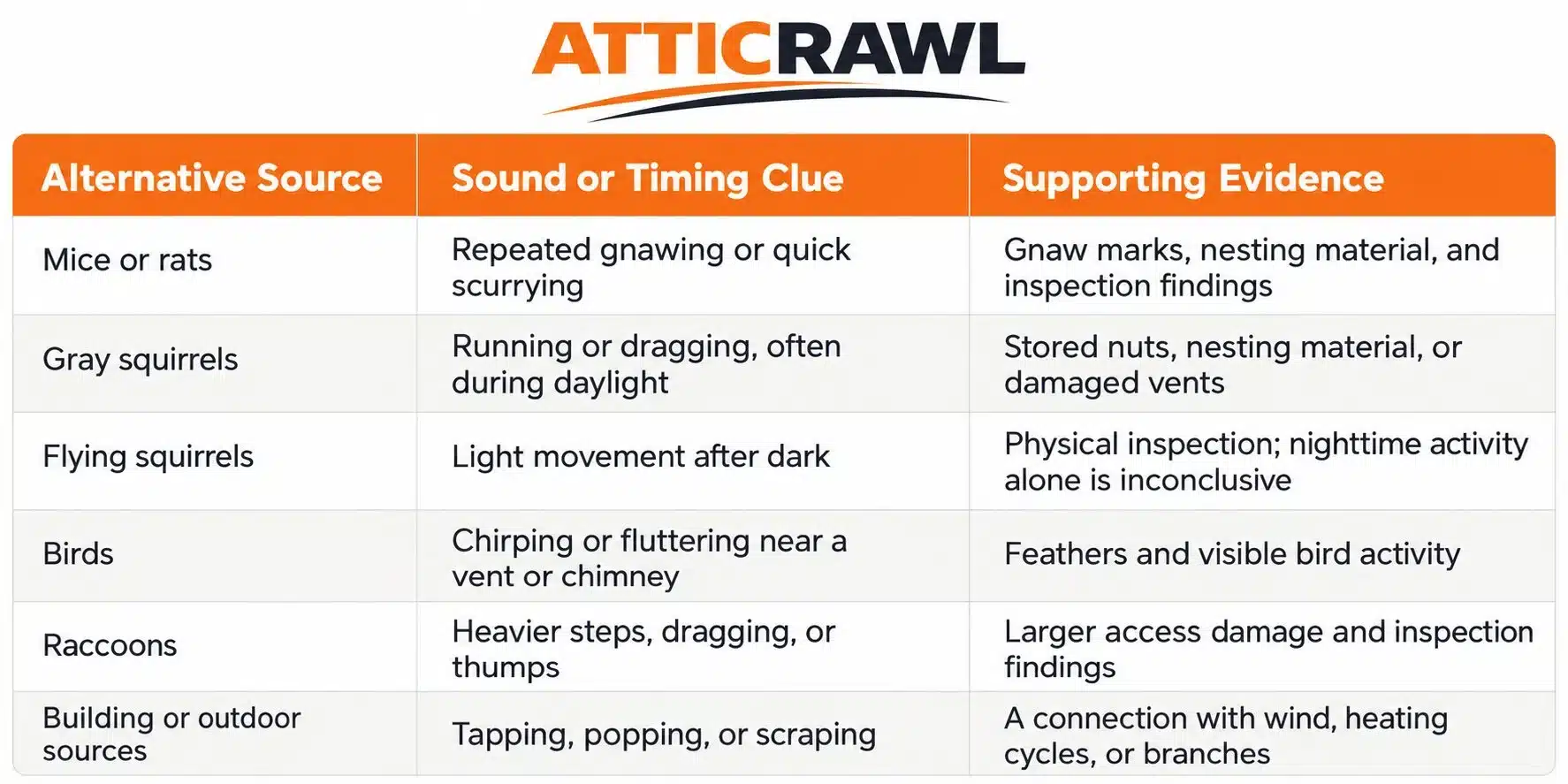
For a closer comparison of the two squirrel types, see what squirrels sound like in an attic.
The final column matters. A sound suggests a possibility, but matching physical evidence helps a professional assess it. We’d give that evidence more weight than a vague impression of the animal’s size based on how loud it sounds.
How Can You Check Whether the Noise Is From Bats?
You can check for bats by combining a sound recording with safely visible exterior evidence and a professional inspection when the cause remains unclear. We recommend gathering these details from living areas and the ground outside, so you can describe the problem without entering the roost.
From our experience, here are four useful checks you can make:
- Record the activity. When attic noise at night repeats, note its time, duration, room, and pattern. A short phone recording can help explain what you heard.
- Watch likely exits. On a suitable dry evening, watch roofline openings around dusk. Bats emerging from the building are stronger evidence than bats flying over the yard.
- Photograph visible signs. From a safe position, capture gaps, staining, or droppings. Old marks may remain after animals leave, and droppings should stay untouched.
- Ask for confirmation. If the clues conflict or the area is inaccessible, arrange an inspection. One quiet watch cannot establish that the space is empty.
The CDC says bats can fit through openings as small as ¼ inch. That helps explain why a narrow roofline gap deserves attention, although its size cannot identify the occupant.
Your notes can follow this format so the inspector can review everything together:
- Time
- Duration
- Room
- Noise
- Weather
- Visible activity
Keep the original recording with the same dated entry. If weather limits the watch, note that too so the observation has context.
What Should You Do If You Hear Bats in Your Walls?
Arrange a professional assessment before opening or altering a wall cavity if you suspect bats are inside. We understand the urge to locate the animal immediately, but blind repairs can make the situation harder to resolve.
Suspected bat sounds in house walls may come from a cavity connected to the attic, soffit, or roofline. The access route and occupants need confirmation before anyone decides where to intervene.
Cutting drywall or probing the space can disturb concealed animals, and filling the cavity may block a route they use. Leave the area intact until the assessor explains how the space will be checked and what work, if any, is needed.

How Do You Get Rid of Bats in an Attic?
Humane exclusion gets bats out by letting them leave and preventing their return. The timing matters because young or hibernating bats may be unable to exit safely.
Here are the four stages:
- Check timing and conditions. A professional should identify the active roost and assess whether exclusion is appropriate under current local guidance. Colony condition matters alongside the calendar.
- Arrange one-way exclusion. Suitable devices allow bats to leave through confirmed exits. Other access gaps are addressed as part of the plan so the bats cannot simply return elsewhere.
- Verify departure, then seal. The remaining openings should close only after checks confirm the bats have left. Sealing too early can trap them within the building.
- Assess cleanup and damage. Once exclusion is complete, inspect affected materials. Some areas may need limited cleanup, while widespread contamination or damaged insulation may require further restoration.
NJDEP lists April 1-May 14 and August 1-October 15 as New Jersey’s safe exclusion dates. Those windows still require an assessment of the property and any applicable local requirements. For homes outside New Jersey, the relevant state’s guidance should set the schedule.
For a closer look at the process, read our guide to how humane bat exclusion works. You can also check out this quick TikTok to learn some tips:
@critter_man513 Have you ever had bats in your house? Here is how we do our bat exclusions. #bat #bats #anjmals #nuisancewildlife #pest #pests #pestcontrol #cincinnati #ohio #lawrenceburg #812 #513 #crittercam #wildlife #didyouknow #fyp #fypage #fypシ #foryou #foryoupage #foryourpage #tiktok #viraltiktok #viralvideo #guano #wildlifecontrol ♬ original sound – CritterCam
Who Should You Call for Bats in the Attic?
New Jersey homeowners can contact Atticrawl for an evaluation of suspected bats and humane removal when bats are confirmed.
Our team can assess the entry points and affected attic areas, then explain which services fit the findings. Atticrawl’s bat removal services cover humane removal, sealing entry points, and restoration where needed.
When you reach out, share when the activity started, where you hear it, and any safely taken photos or recordings. That gives us a clearer starting point for discussing your home and the concern.
You can request an evaluation and free estimate through our contact page or call 800-682-1602. We’ll help you understand the proposed work before you decide how to proceed.
FAQs
What Does a Bat Sound Like When It Is Flying?
You may hear nearby wingbeats. Most echolocation exceeds the approximate human hearing limit of 20,000 hertz given by the National Park Service. Slowed detector recordings can make those calls audible to us.
Can You Hear Bats in Your Attic?
Sometimes. Your hearing, distance from the roost, and the materials between you and the bats all affect what you hear.
Should I Worry About Bats in My Attic?
Yes, confirmed attic activity warrants a professional assessment of the space. Rabies concerns involve possible contact, while histoplasmosis can result from inhaling fungal spores in contaminated material. Hearing a noise alone does not establish a health exposure.
Is It Safe to Sleep in a House With Bats?
Suspected attic activity needs assessment, while a bat found in a sleeping room needs prompt advice from a health department or clinician. A sleeping person may miss a bite or contact, and a visible mark may be absent. Keep your distance and avoid handling or releasing the bat until public health officials advise you.
Will Bats Leave My Attic on Their Own?
Possibly, but leaving to feed does not mean bats have abandoned the attic. They may return afterward.
What Smell Do Bats Hate Most?
No particular smell is established as a reliable attic solution. We would avoid relying on scents to resolve a roost.
How Long Can a Bat Live in Your Attic?
There is no fixed duration. Occupancy depends on species, season, and access, so a bat’s lifespan cannot predict how long your attic stays occupied.
What Time of Year Are Bats Most Active?
In New Jersey, activity is greater during warmer months, with maternity colonies raising young in summer. Some bats also occupy buildings during winter.



Recent Comments