


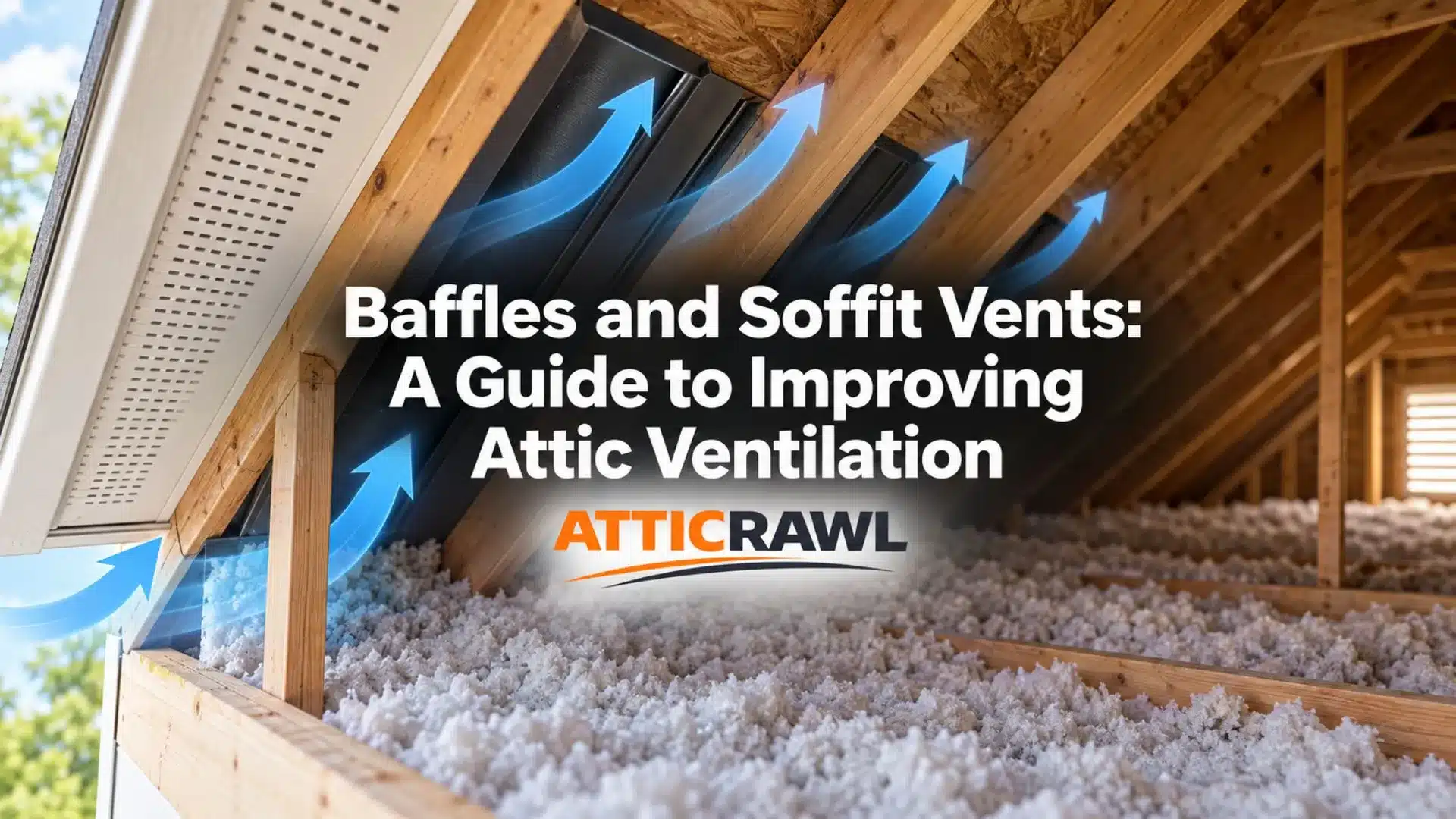
When you’re adding attic insulation, it’s common to notice things you probably never paid much attention to before. Around the eaves, you might see soffit vents, plastic or foam channels between the rafters, and insulation sitting close by. Those parts all have a job, and the way baffles and soffit vent openings work together can make a real difference to attic airflow.
In this guide, we’ll walk you through how that airflow moves, where insulation fits into the picture, what proper installation should look like, and which warning signs can point to a ventilation problem.
P.S. Have questions about your attic insulation or airflow? Contact Atticrawl today to schedule an evaluation.
TL;DR
- Soffit vents bring fresh air into the attic through openings along the eaves.
- Baffles keep that airflow path open between the soffits, insulation, and roof deck.
- Upper exhaust vents are still needed so incoming air has a way to leave the attic.
- Blocked soffits reduce ventilation and can contribute to excess heat, condensation, roof-deck moisture, and winter ice problems.
- Baffles should stay clear of insulation and extend above the finished insulation level.
- Ventilation should be properly balanced between lower intake and upper exhaust.
- Before adding insulation, inspect the eaves, baffles, and exhaust vents so airflow problems can be fixed first.
What Are Soffit Vents and Attic Baffles?
Soffit vents are intake openings near the lower edge of the roof, while attic baffles create a clear path for that air to move into the attic. You’ll usually find soffit vents underneath the roof overhang, where fresh outdoor air can enter through the eaves.
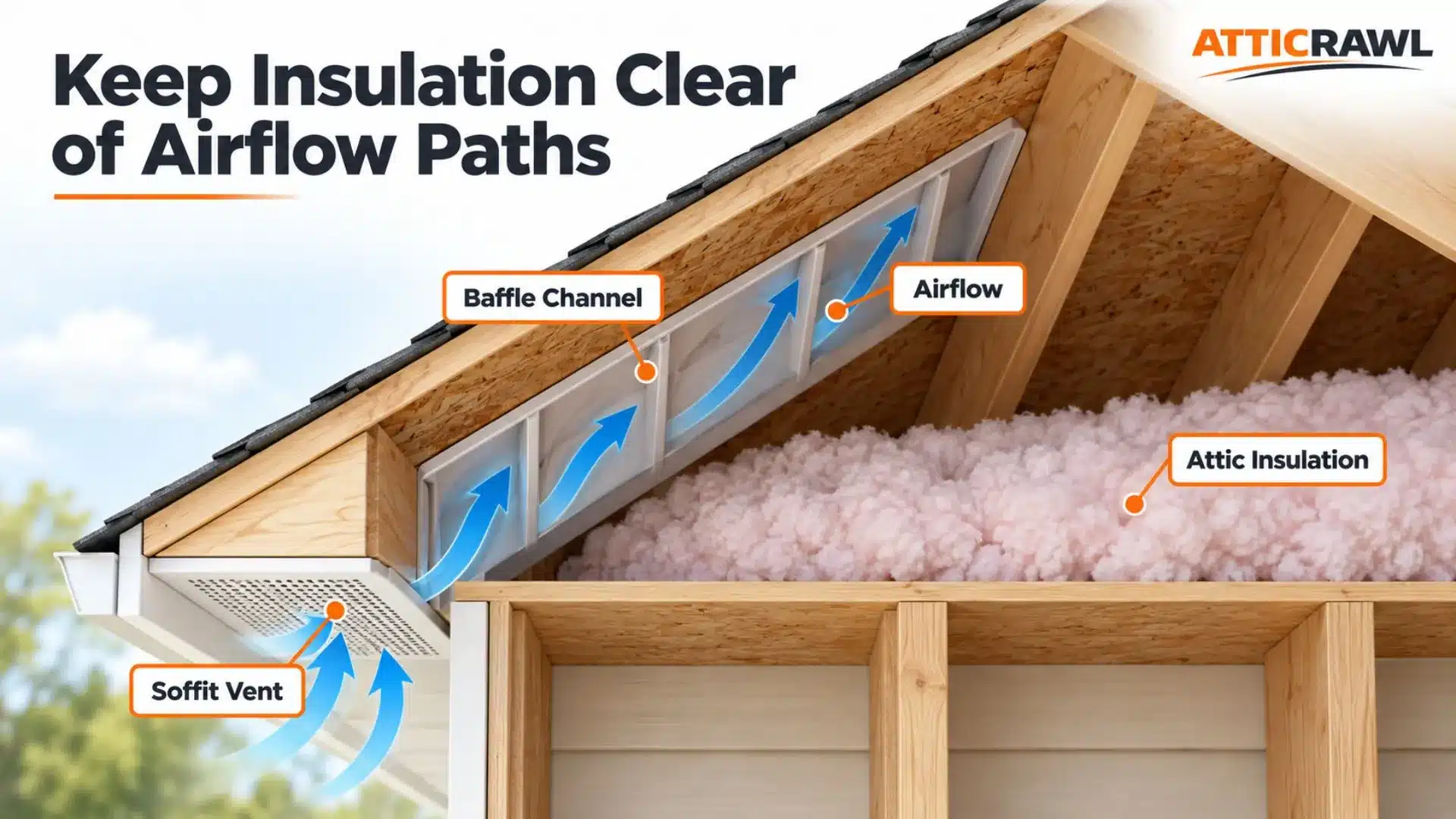
If you’re wondering what soffit baffles are, you may also hear them called attic baffles, rafter vents, or ventilation chutes. They sit between the roof deck and the insulation, and their job is to keep that narrow airflow path open.
That space can easily get blocked if insulation shifts or gets packed too far into the eaves, so baffles help keep the intake area clear.
From there, the air still needs somewhere to leave. A vented attic usually relies on an upper exhaust point, such as a ridge vent or another approved roof vent, to complete the airflow path.
How Do Baffles and Soffit Vents Improve Attic Ventilation?
Baffles and soffit vents improve attic ventilation by creating and protecting the low-to-high airflow route through a vented attic. The soffit brings air in, and the baffle gives that air a clear path past the insulation.
The system works best when every part of that route remains open. Here are the three parts of the airflow sequence that matter most.
Soffit Vents Supply the Low-Level Intake Air
Outside air first enters through soffit vents along the lower edge of the roof. From there, the ventilation system needs enough open area for air to move into the attic without unnecessary restriction.
This is where net free ventilation area becomes important. A vent may look large from the outside, yet screens, louvers, and grilles reduce the space through which air can actually pass. For that reason, vent sizing should rely on the manufacturer’s net free ventilation area rather than the visible dimensions alone.
The soffit ventilation baffles then help preserve the path beyond those intake openings so the air can continue into the attic.
Baffles Keep the Intake Path Open Above the Insulation
Once air enters through the soffit, it needs a clear channel between the insulation and roof sheathing. Baffles provide that separation.
This becomes especially important near the eaves, where space often gets tight. Insulation still needs to reach the perimeter of the attic floor, so the baffle creates room for both insulation and airflow.
Loose-fill insulation can move toward the edges of the attic over time, and installation equipment can also push material into the eaves. Proper soffit vent insulation baffles help contain that material and keep the intake route open.
The Open Channel Allows Air to Continue Toward the Exhaust Vents
After air passes through the baffle channel, it reaches the larger attic space and can continue toward the upper exhaust vents. That movement helps remove excess heat and supports the drying of moisture that reaches the attic.
A working airflow path can also reduce conditions that contribute to condensation, roof-deck moisture, and winter ice problems. We still recommend treating ventilation as one part of the attic system because air sealing, insulation, duct conditions, and indoor humidity also affect moisture and energy performance.
This broader approach is reflected in a 2021 U.S. Department of Energy factsheet. It reports that a correctly installed, comprehensive vented-attic upgrade can reduce average total home energy use by about 10% to 15%. Those savings come from a package that includes ventilation, baffles, air sealing, insulation, and duct improvements, so they cannot be assigned to soffit vents or baffles alone.
For that reason, attic baffles for soffit vents work best when the rest of the attic system supports the same airflow strategy.
How Should Baffles and Soffit Vents Be Sized and Positioned?
Baffles and soffit vents should be sized and positioned so they preserve a continuous intake pathway while meeting the ventilation requirements for the attic. The correct setup depends on attic area, vent placement, roof design, and the products being used.
A baffle also needs enough clearance to remain effective after the insulation reaches its final depth. These are the main points homeowners should understand.
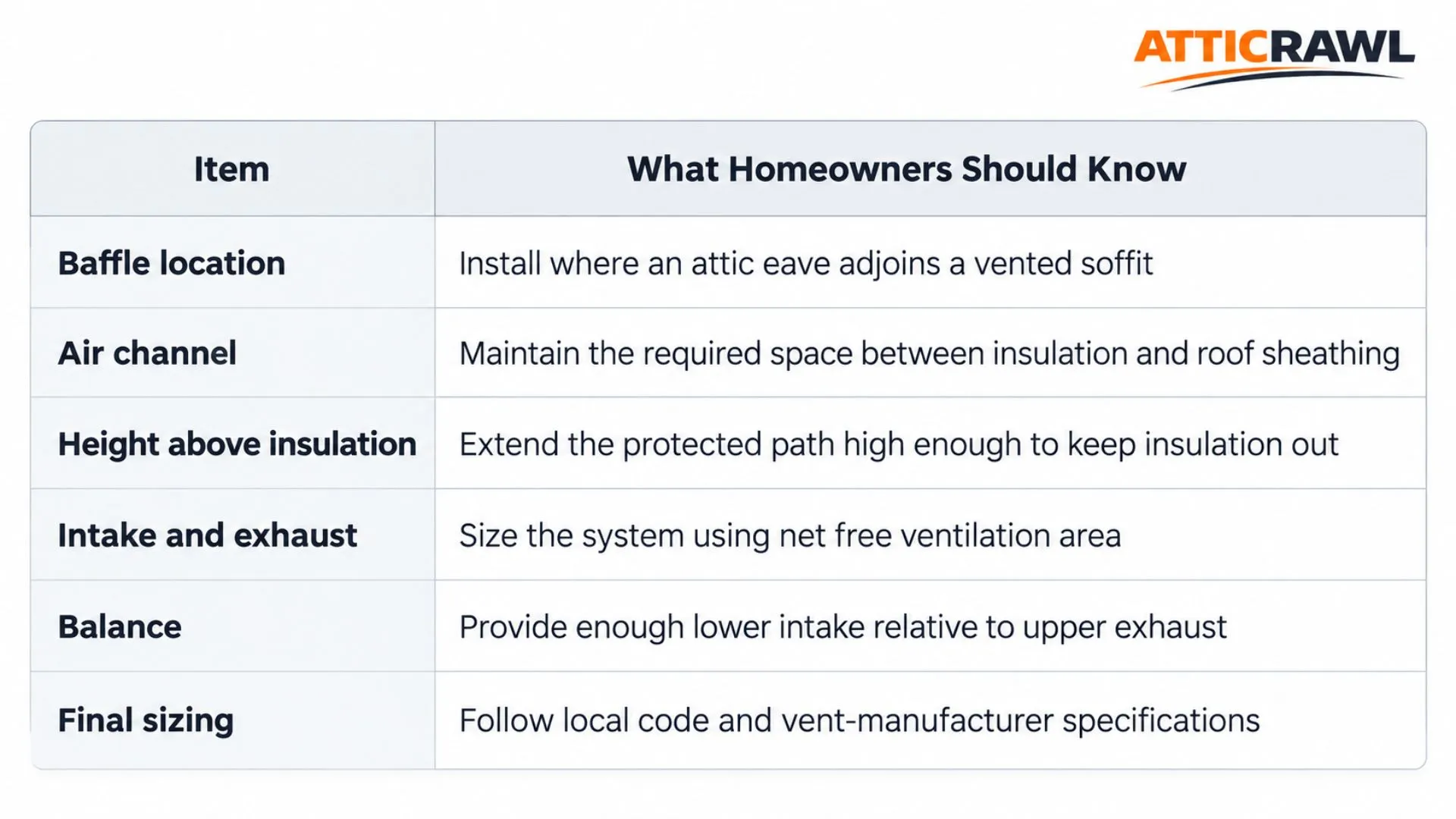
The 2021 IRC uses 1 square foot of net free ventilating area for every 150 square feet of vented attic space as its baseline. Under qualifying conditions, it permits a reduced 1:300 ratio.
Balance also matters under that 1:300 exception. At least 40% and no more than 50% of the ventilation area should be located in the upper part of the attic, while roughly 50% to 60% remains lower, where soffit vents commonly provide intake.
Baffle placement has its own requirements. DOE guidance calls for a baffle or wind block at every attic eave that adjoins a vented soffit. It also requires at least a 1-inch clear airflow path, and the protected channel should extend at least 6 inches above the finished insulation height.
A properly installed soffit ventilation baffle needs to meet those clearances while fitting the actual roof assembly. There is no single vent count that works for every house because NFVA ratings, attic dimensions, roof configurations, and local requirements vary.
How Should Attic Insulation Be Installed Around the Ventilation Path?
Attic insulation should cover the attic floor to the required depth while remaining physically separated from the airflow path at vented eaves. That separation allows the insulation and ventilation system to do their jobs at the same time.
Near the roof edge, installers need to preserve the baffle channel and keep soffit openings clear. Batt insulation should stay at its intended thickness because compression reduces performance, while loose-fill materials need containment so they do not spill into the eave area.
The type of insulation matters as well. Fiberglass batts, blown cellulose, and spray foam involve different installation methods, so homeowners should understand how much attic insulation you need and how that final depth will fit around the ventilation path.
Material selection can affect the rest of the assembly too. Our guide to choosing the right attic insulation explains how fiberglass, cellulose, and spray foam differ and why the attic’s existing conditions should influence the choice.
Properly placed attic soffit vent baffles make that planning easier because they establish a clear boundary between the insulation layer and ventilation channel.
DOE installation guidance also limits gaps, voids, and compression in attic insulation to less than 2%. A defined baffle channel helps installers maintain consistent coverage near the eaves without filling the space needed for airflow.
What Happens When Insulation Blocks Soffit Vent Airflow?
When insulation blocks soffit vent airflow, the amount of replacement air entering the attic decreases, and the ventilation system becomes less effective. The problem starts at the intake and then affects the rest of the system.
Insulation may cover the soffit opening directly or spill into the channel above it. As intake airflow drops, heat and moisture can remain in the attic for longer periods. That can increase the chance of condensation, moisture on the roof deck, and winter ice-related problems under the right conditions.
Blocked intake can also reduce the effectiveness of an otherwise adequate exhaust system. Upper vents need replacement air from below, so restricted soffits can leave the overall system out of balance.
Poor installation around the baffle soffit area is one example of how insulation work can interfere with ventilation. Our guide to common attic insulation installation mistakes covers this issue in more detail, including the risk of covering ventilation channels at the eaves.
If your attic ventilation or insulation needs attention, contact our team, and we’ll help you plan the next step.
How Can You Tell If the Soffit-to-Baffle Airflow Path Is Blocked?
You can often identify a blocked soffit-to-baffle airflow path by inspecting the eaves for insulation, damaged baffles, moisture marks, or missing openings. Some problems are obvious once you reach the attic, while others require a closer look.
The condition of the channel usually tells you more than the exterior vent alone. Here are the main signs worth checking:
- Insulation visibly covers the eave openings.
- Baffles are crushed, missing, displaced, or too short.
- Loose-fill insulation has spilled into the airflow channel.
- Existing baffles end below the finished insulation height.
- Roof sheathing near the eaves looks damp or stained.
- Condensation or frost appears during cold weather.
- Exterior soffit vents are present, yet there is no clear opening from them into the attic.
Attic access also deserves some caution. Floor joists may be hidden under insulation, and stepping between them can damage the ceiling below or cause an injury. If visibility is poor, access is tight, or you cannot safely reach the eaves, we recommend having the attic inspected professionally.
How to Check Baffles and Soffit Vents Before Adding New Insulation
Ventilation conditions should be checked before additional insulation is installed because the eaves become harder to reach afterward. A short inspection now can reveal problems that would otherwise become buried under new material.
1. Identify Which Soffit Areas Actually Provide Intake
First, determine whether the soffit uses continuous ventilation or individual vent openings. This shows you where functional intake air should be entering the attic.
2. Inspect the Eaves From Inside the Attic
Next, look from the soffit opening toward the attic. There should be a clear route into the ventilation channel without insulation packed across the opening.
3. Check Each Existing Baffle
Then, inspect the baffles for damage, movement, or gaps. They should sit securely and extend high enough to remain clear after the planned insulation reaches its finished depth.
4. Review the Upper Exhaust Ventilation
The intake system also needs a suitable upper exit. Check that the attic has an appropriate exhaust path so air entering at the soffits has somewhere to leave.
5. Correct Airflow Problems Before Adding Insulation
Finally, address blocked eaves, damaged channels, or clearance problems before new insulation goes in. Once the attic floor is covered more deeply, correcting those issues usually takes more effort and may disturb newly installed insulation.
How Can Atticrawl Help Protect Attic Airflow During Insulation Work?
Atticrawl can help homeowners protect attic airflow by evaluating existing conditions and planning insulation work around the ventilation clearances that need to remain open. This is especially useful when insulation has shifted into the eaves, the attic needs additional insulation, or existing material needs to be removed and replaced.
Atticrawl serves homeowners across New Jersey and Eastern Pennsylvania and works with attic insulation as part of the larger attic system. During insulation work, the airflow path at vented eaves needs to remain clear so new material does not bury or obstruct it.
If you’re planning an upgrade, you can learn more about Atticrawl’s professional attic insulation installation service and the options available for improving attic insulation while preserving necessary clearances.
Ready to improve your attic setup? Contact Atticrawl for professional guidance and a free estimate.
The Bottom Line
Soffit vents bring outside air into a vented attic, while baffles protect the pathway that carries that air beyond the insulation. When either part becomes blocked, damaged, or poorly positioned, the entire ventilation system can lose effectiveness.
Before adding new insulation, check the eaves, baffle channels, and upper exhaust path. Correcting airflow restrictions first helps the finished attic system work the way it was designed to.
FAQs
Do I Need Baffles If There Are No Soffit Vents?
The answer is usually no for a standard soffit-to-rafter ventilation path. Baffles primarily preserve airflow from a functioning low-level intake. Without soffit intake, a standard baffle does not create ventilation by itself. The correct solution depends on the attic’s complete ventilation design.
Does Every Rafter Bay Need a Baffle?
Every rafter bay does not automatically need a baffle. Baffles are generally required where airflow must be preserved from vented soffits. Continuous soffit ventilation may call for baffling across more bays, while individual intake vents can lead to a different layout. Local requirements and the actual vent design should guide placement.
Can You Have Too Many Soffit Vents?
Yes, a ventilation system can be poorly proportioned even when it has plenty of soffit openings. The important factor is balanced net free ventilation area. Intake capacity should support the exhaust system, and sizing should account for attic area, vent ratings, local requirements, and the manufacturer’s specifications.
Can Baffles Prevent Attic Condensation by Themselves?
No. Baffles help ventilation support drying, but condensation can also develop when warm, moisture-laden indoor air leaks into a cold attic. Air sealing, suitable insulation, indoor humidity control, and proper ventilation all work together to reduce that risk.



Recent Comments