


You hear movement above the ceiling, and the first thought may be simple. There are bats in my house, so how do I get them out? That reaction makes sense, but closing an active opening too early can interfere with humane exclusion and leave bats trapped inside. If you are figuring out what to do with bats in the attic, the order matters.
In this guide, we’ll walk through why bats use these spaces, how exclusion works, when sealing should happen, and what to inspect afterward.
Why Bats Keep Returning to Attics and Roof Gaps
Bats use protected building spaces because they offer warmth, shelter, and stable places to roost. Some species may also form maternity colonies during warmer months. Once a structure works well for them, the same access route can stay useful season after season.
That is why homeowners usually wonder, “How do bats keep getting in my house?” after seeing activity return. And the opening may be surprisingly small. CDC guidance says bats can enter through a gap only ¼ inch wide and recommends sealing openings larger than a dime while screening vents, chimneys, and attic doors.
Soffits, fascia, roof edges, flashing, vents, siding transitions, and utility penetrations can all give bats a way back inside. That is why finding and addressing these vulnerable areas matters just as much as removing the current colony.
Here you can learn how they beehive in different places:
How to Remove Bats From Your Attic Humanely and Seal the Home
The best way to remove bats from attic spaces is to treat exclusion and structural repair as one connected job. We recommend working in a fixed order because each step sets up the next one.
Here are the steps that matter most.
1. Identify the Active Exit Routes and Inspect the Exterior
Before deciding to remove bats, first determine where they are actively entering and leaving. A dusk observation from a safe spot can help map those routes without disturbing the roost.
Then inspect the rest of the roofline for secondary openings. This matters because bats may shift to another available gap once exclusion begins. Finding those openings early gives you a clearer plan for the sealing work that follows.
P.S. Here are some interesting facts about bats:
2. Check the Season Before Starting Exclusion
Timing matters because young bats may stay inside while adult females leave to feed. If exclusion begins during a maternity period, flightless pups can become separated from their mothers.
U.S. Fish and Wildlife Service guidance describes May 15 through August 15 as a typical maternity period and advises against exclusion during that window, though timing varies by species and location. A female little brown bat generally has one pup per year after a 50- to 60-day gestation, and young bats can fly after about four weeks.
For that reason, check local wildlife guidance before work begins.
3. Seal Secondary Gaps Before Closing the Active Exit
Once the main exit is confirmed, address other suitable openings so bats cannot simply move to another part of the roof. If you want to get rid of bats in roof spaces for the long term, this secondary sealing work matters.
Repairs may involve roofline gaps, fascia transitions, damaged screens, vents, flashing, or small penetrations. The material should suit both the opening and surrounding construction. During this stage, keep the confirmed active exit available for the exclusion device.
4. Install One-Way Bat Exclusion Devices
A one-way exclusion device gives bats a route out and blocks their return through that same opening. This is the core method used to remove bats humanely from an active roost.
Tubes, valves, or properly installed exclusion material can serve this purpose when they are fitted over confirmed exit routes. The goal is to get rid of bats in attic spaces through controlled departure. Simply covering occupied openings can trap animals inside or push them toward another part of the structure.
5. Confirm the Bats Have Left Before the Final Seal
The final opening should be closed only after the exclusion system has worked and activity has been checked. One quiet observation is rarely enough to prove the roost is empty.
This verification helps prevent bats from becoming trapped inside walls or attic cavities. Once departure is confirmed, remove the device and repair the final access point with a durable material suited to that part of the building.
That final closure helps prevent bats from returning through the same access point after exclusion is complete.
6. Reinspect the Attic After Exclusion Is Complete
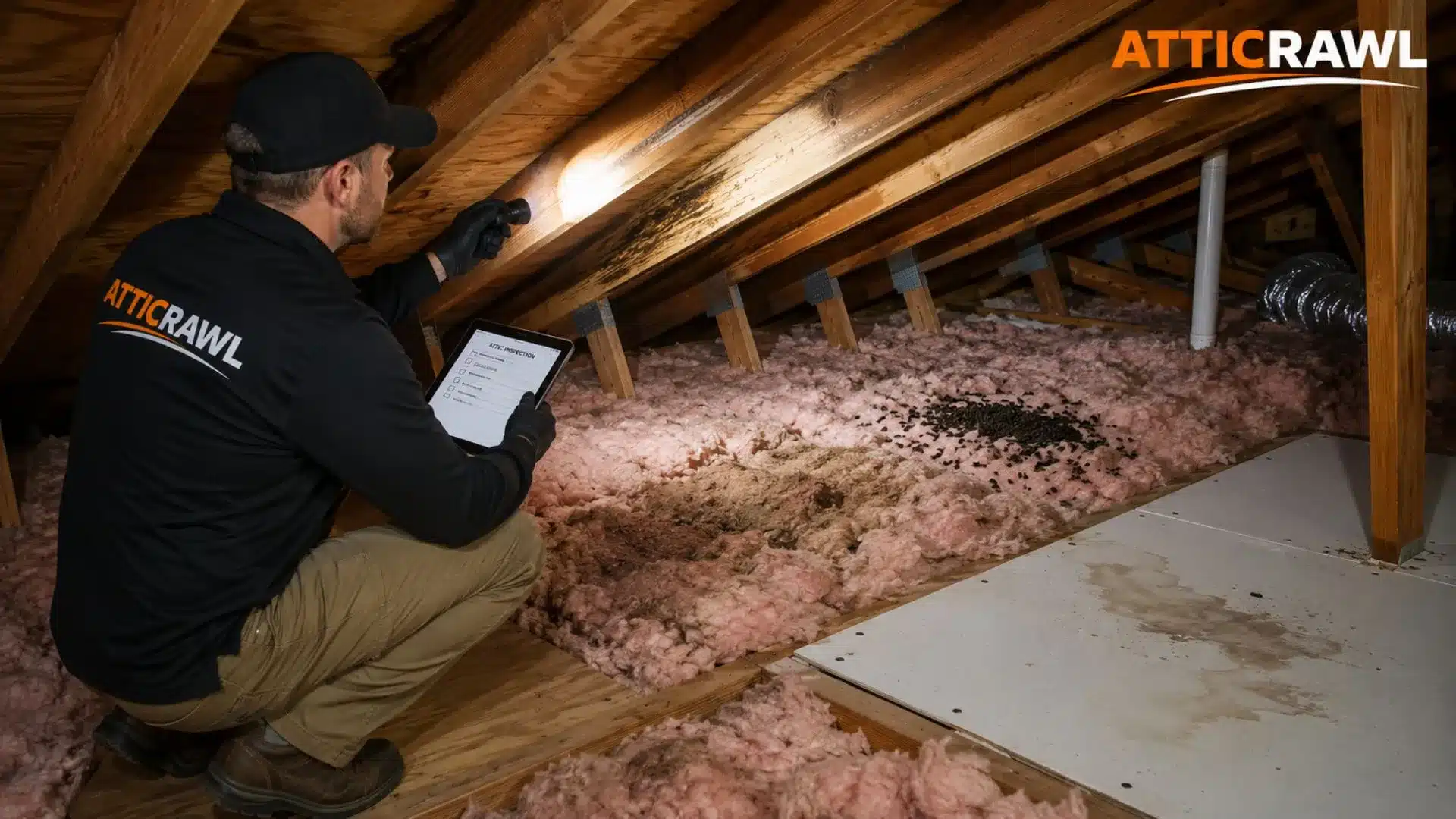
After the exterior work is finished, go back to the attic and assess what remains. Successful exclusion solves the access problem, while the space itself may still contain droppings, debris, odors, staining, damaged insulation, or affected building materials.
We recommend treating this as a separate restoration decision. A small localized issue may call for limited cleanup. Heavy contamination or widespread insulation damage may require more extensive work. The inspection tells you what actually needs attention next.
What Should You Inspect After the Bats Are Gone?
After the bats are gone, inspect the attic for contamination, damaged insulation, and affected building materials so you can determine the scope of restoration. If bats in your attic used the space for some time, conditions may vary considerably from one area to another.
Here are the main areas to check:
- Droppings and debris: Note where material is concentrated and how far it extends. That helps define the cleanup area.
- Insulation condition: Look for stains, compressed sections, strong odors, or widespread contamination. If material needs to come out, our guide to attic insulation removal and replacement explains the next steps.
- Wood, drywall, and ceiling areas: Check for visible staining or damage that extends beyond loose-fill or batt insulation.
- Whether replacement is necessary: A bat problem does not automatically mean every section of insulation has to be discarded. Our guide on when pest-damaged insulation needs replacement explains how the condition and extent of damage can guide that decision.
When Should You Call a Professional for Bat Removal?
You should call a professional when safe access, exclusion timing, multiple entry points, recurring activity, or attic cleanup makes the work difficult to manage yourself. We find the decision becomes clearer once you separate basic observation from roof work and full exclusion.
These are the situations where professional help usually makes the most sense:
| Situation | Why It Complicates DIY Work | What Professional Help Can Address |
| Steep or difficult roof access | Safe inspection is limited | Exterior inspection and access-point work |
| Several possible entry points | Active and secondary gaps are harder to distinguish | Full-building exclusion planning |
| Recurring bat activity | Previous sealing may have missed openings | Reinspection and durable repairs |
| Significant attic contamination | Cleanup may extend beyond wildlife removal | Evaluation, cleanup, and restoration needs |
| Uncertain exclusion timing | Colony stage may be unclear | Appropriate next-step planning |
When comparing companies that remove bats, look at their inspection scope, humane exclusion method, sealing approach, and attic-restoration experience. If you are unsure who to call to remove bats, those details tell you far more than a general service label.
Professional pricing can also change based on the property, roof access, entry points, colony conditions, sealing work, and restoration scope.
How Can Atticrawl Help With a Bat Problem in Your Attic?
Atticrawl can help New Jersey homeowners remove bats humanely, seal entry points, and restore affected attic areas after the colony is gone. Our professional bat removal services follow that complete process, so the work can address the animals as well as the access problem that allowed them inside.
Because every attic is different, an inspection helps determine what the home actually needs before work begins. This may include exclusion, sealing, cleanup, or restoration based on the condition of the space.
If roof access feels unsafe or the attic condition is difficult to judge, we recommend requesting an evaluation and free estimate so the next step is based on the home itself.
Conclusion: Remove the Colony and Fix the Access Problem
Lasting bat control comes down to sequence. Let the colony leave through humane exclusion at the right time, close the routes that allowed access, and then inspect the attic for cleanup or restoration needs that remain.
When the roof is difficult to reach, the colony is complicated, or the attic needs substantial recovery work, professional help can make the process safer and more complete.
FAQs
How Do You Know If Bats Are in Your Attic?
Common signs of bats in the attic include dusk emergence, guano, chirping or fluttering, stains around entry routes, and repeated bat appearances. If you wonder what do bats in the attic sound like, check out our other guide on what nighttime attic noises can mean to learn more.
Can Bats in the Attic Make You Sick?
Yes, bats can create health concerns in some situations. Everyone is asking us, “Are bats in the attic dangerous?” Well, rabies matters after possible direct contact, while histoplasmosis can relate to contaminated droppings and material.
Around 5% of bats submitted for U.S. rabies testing are positive, though those bats are specifically selected for testing. Follow public-health guidance after a possible exposure. Watch this video for Mayo Clinic to learn more:
Is It Legal to Remove Bats From Your Attic Yourself?
Sometimes, but removal rules vary by state, species, season, and local wildlife requirements. Check your state wildlife agency before starting exclusion so you know which methods and timing are allowed where you live.
How Long Does Professional Bat Exclusion Take?
There is no universal timeline. Inspection findings, colony conditions, entry points, monitoring, weather, and repair scope can all affect the schedule. A professional inspection can give you a clearer idea of how long the exclusion process may take for your specific home.



Recent Comments