


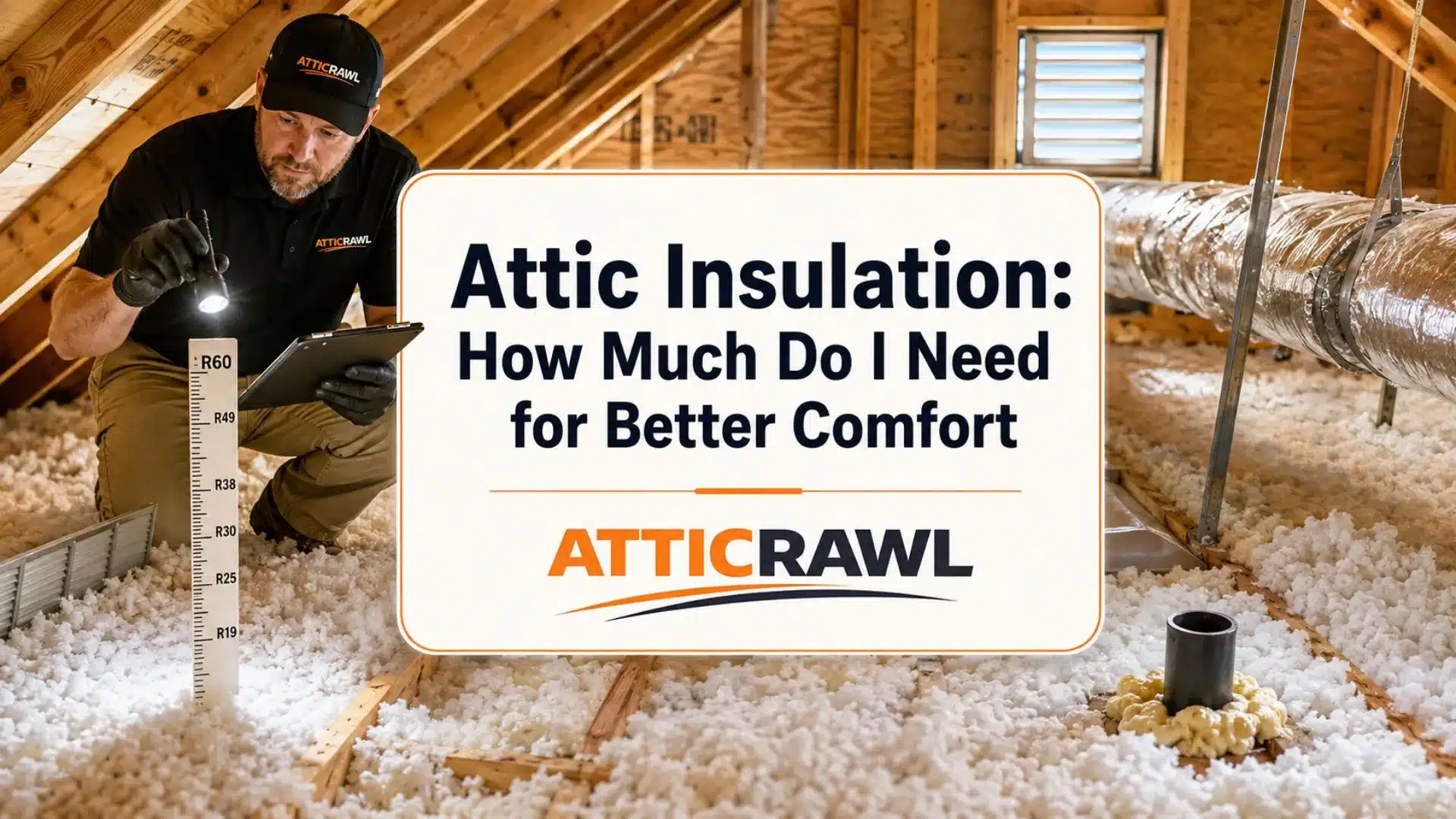
Some rooms stay stubbornly hot in summer or cold in winter even while the HVAC system keeps running. Then you look into the attic, see insulation across the floor, and still have no clear sense of whether there is actually enough.
Well, that situation is more common than you think. A 2024 ICF study estimated that 78% of ceilings and roofs in U.S. single-family detached homes were under-insulated compared with its benchmark.
So when you ask yourself about attic insulation and how much do I need, inches alone cannot answer it. Climate, existing R-value, insulation material, coverage, and installation quality all matter.
For that reason, we’ll walk you through how to estimate the right amount, use a calculator, understand installation and costs, and know when professional help makes sense.
How Much Insulation Do I Need in My Attic (Calculator)
The amount of insulation you need depends on your attic’s current insulation, target R-value, climate, square footage, and the material you plan to add. A calculator can bring those pieces together and give you a useful estimate of how much additional insulation the attic may need.
But we recommend that you treat the result as a planning figure. Manufacturer coverage charts, product-specific R-values, required installed depth, settling, and the actual condition of the attic will determine the final quantity.
How Much Insulation Do I Need in My Attic?- Calculator
Estimate your current attic R-value, the additional R-value you may need, and the approximate insulation depth required to reach your target.
Additional R-value ÷ new insulation R-value per inch = approximate added depth.
Your Estimate
Use these numbers as a quick planning guide before checking the attic, product label, and local requirements.
The calculator gives you the number, but understanding where that number comes from makes the result much more useful. It also helps you spot a result that does not make sense for the attic you are looking at.
Here are the three parts we would check if we were in your scenario.
Start With the Performance Level Your Attic Needs
Your climate has a major influence on the insulation level the attic should reach. A home that deals with long, cold winters has different thermal demands from a home in a much warmer region.
Applicable energy guidance and local building requirements provide a useful starting point. The age and construction of the home matter too, especially when you are comparing an older attic with current minimum attic insulation requirements.
We see code values as the baseline for the calculation. An existing home may have older insulation, previous upgrades, additions, unusual roof construction, or other conditions that change what the attic needs today.
Measure What Is Already in the Attic
Next, identify the existing insulation material before you measure its depth. 10 inches of one material can provide a different R-value from 10 inches of another.
So, measure several locations across the attic because insulation typically settles unevenly. Pay particular attention to thin areas, compressed sections, edges, and places where the material has shifted.
ENERGY STAR says common fiberglass, cellulose, and mineral-wool insulation generally provide around R-3 to R-3.5 per inch. So, as a quick first estimate, multiplying the measured depth by roughly three can give you a rough idea of the existing R-value.
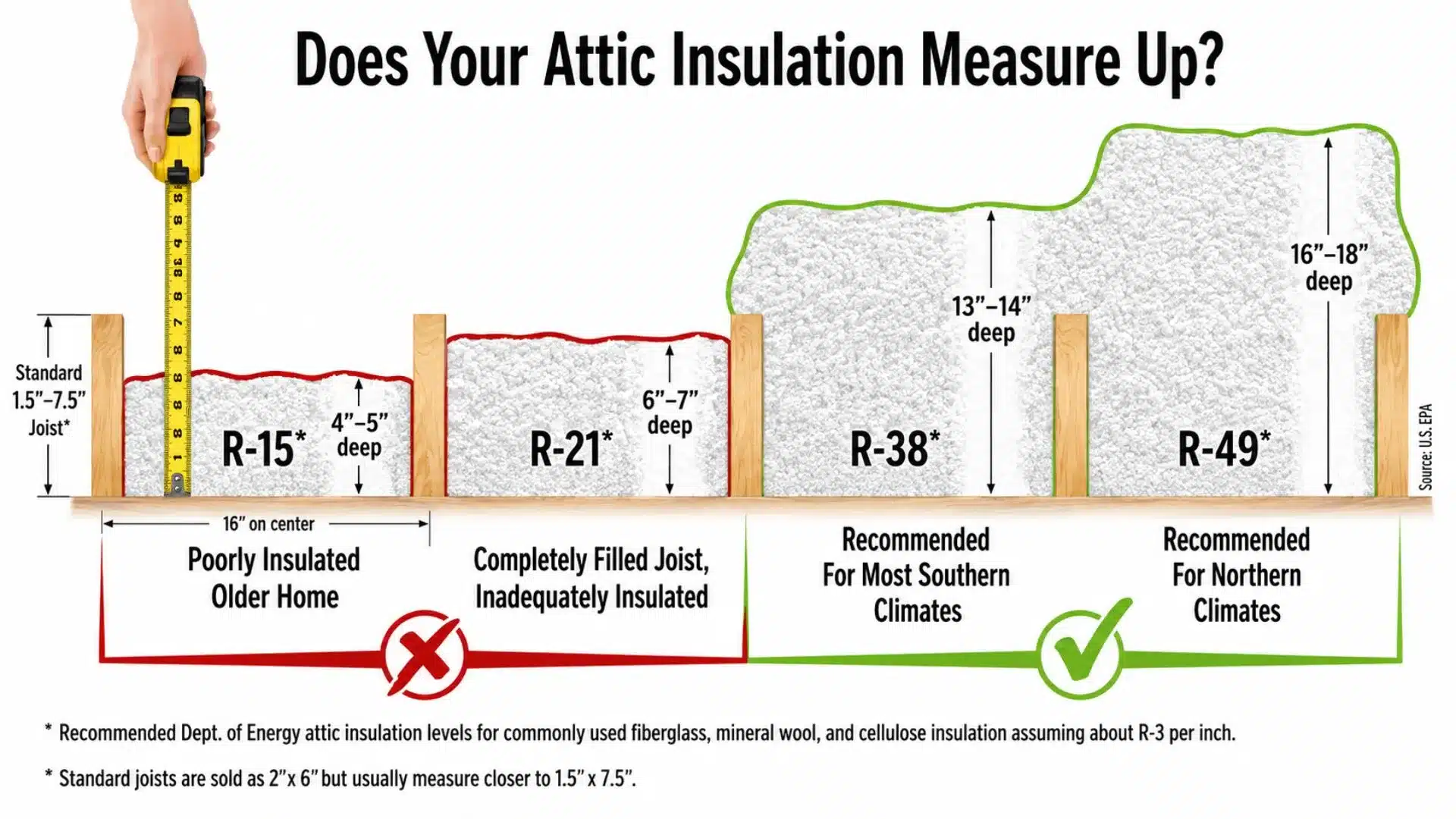
Source: ENERGY STAR
If you can identify the actual product, use its manufacturer information instead. That will give you a more accurate figure than a general rule of thumb.
Calculate the Gap and Convert It Into Added Depth
Once you know your target and your current effective R-value, the basic calculation is straightforward:
| Target R-value − effective existing R-value = additional R-value needed |
Then convert the missing R-value into depth.
| Additional R-value needed ÷ R-value per inch of the new product = approximate additional insulation depth |
For example, suppose your attic needs R-49, and the existing insulation provides about R-30. You still need roughly R-19. If your chosen product provides about R-3.5 per inch, that works out to a little over five additional inches.
Use that figure as a starting point. The product label and coverage chart should determine the actual installed depth and number of bags, rolls, or batts required.
Loose-fill insulation also deserves extra attention because installed depth and settled depth can differ over time. And since material affects the number of inches required, our guide to the best type of attic insulation can help you compare fiberglass, cellulose, and spray foam before choosing a product.
Attic Insulation: How to Install It Properly for Better Home Comfort
Getting the calculated depth right is only part of a good installation. The attic also has to be prepared properly, and the insulation needs consistent coverage from one area to the next.
Here is the practical order we recommend:
- Inspect the existing attic first: Check whether the old insulation is clean, dry, intact, and suitable to stay. Widespread moisture, pest contamination, or deterioration may call for attic insulation removal and replacement before new material goes in.
- Correct attic problems before covering them: Water intrusion, air leaks, damaged materials, and other accessible problems are easier to address before fresh insulation fills the space.
- Protect ventilation paths and required clearances: Soffit vents, baffles, fixtures, and other areas that require space around them need to remain functional.
- Install insulation to the calculated depth: Keep the coverage even across the attic and pay attention to edges, corners, and awkward spaces.
- Verify the finished coverage: Measure several locations and correct thin, compressed, or missed spots.
Installation quality makes a real difference. DOE field studies found that 90% of observed Pennsylvania ceilings met the nominal R-value requirement. Meanwhile, only 49% met the complete assembly U-factor requirement after installation quality was considered.
The number on the insulation package matters, and the way that insulation sits in the attic matters just as much.
You can watch this video if you plan on installing attic insulation on your own:
Why Better Comfort Depends on More Than Insulation Depth
An attic can reach the planned insulation depth and still leave parts of the house uncomfortable. We usually look at the attic as a connected system because several other conditions can weaken the result.
These are the areas worth checking:
- Air leakage around pipes, wiring, fixtures, penetrations, and attic access points can let conditioned air escape.
- Uneven or compressed insulation can leave weak areas where heat moves more easily.
- Moisture or pest damage can compromise insulation that still appears deep enough. Our guide explains when to replace home insulation when the existing material has deteriorated.
- Damaged or leaking ducts in the attic can contribute to stubborn comfort problems.
- Ventilation problems can affect the overall attic environment and should be addressed as part of the system.
How Much Does Insulation Cost for an Attic?
Attic insulation work can cost anywhere from a few dollars per square foot to several thousand dollars for a full removal-and-replacement project. Atticrawl’s 2026 cost guide places complete removal and replacement at about $2 to $6 per square foot, while many full projects fall between $1,500 and $8,000.
The scope makes a big difference. Here are Atticrawl’s published ranges:
| Project Scope | Atticrawl's Published Range |
| Removal only | $1-$2 per sq. ft. |
| Replacement only | $1.50-$4 per sq. ft. |
| Removal and replacement | $2-$6 per sq. ft. |
| Removal, cleaning, and replacement | $3-$8+ per sq. ft. |
Attic size, material choice, access, contamination, sanitation, air sealing, and cleanup can all affect the final price. For a deeper breakdown, see Atticrawl’s attic insulation removal and replacement cost guide.
Who Can Add Insulation to My Attic?
A qualified attic insulation contractor can measure the existing coverage, assess its condition, calculate how much more insulation is needed, and install the new material evenly.
At Atticrawl, we specialize in attic and crawl-space work for homeowners across New Jersey and Eastern Pennsylvania. We offer several insulation options and help homeowners determine which approach fits the condition and construction of their home.
Our team brings more than 33 years of experience, and Atticrawl is fully licensed, bonded, and insured. We also handle related work such as insulation removal, attic cleaning, air-gap sealing, and duct repair or replacement when the attic needs more than a simple top-off.
If you want the existing insulation checked before deciding how much to add, our attic insulation installation services can help you plan the next step and request an estimate.
FAQs
Can You Have Too Much Attic Insulation?
Yes, attic insulation can reach a point where adding more provides very little additional benefit. Excess material can also create practical problems when it blocks soffit ventilation, covers required clearances, or interferes with fixtures. The correct target matters more than simply adding depth.
How Much Attic Insulation Do Most Homes Actually Need?
Many homes need roughly 9 to 20 inches of common attic insulation, depending on climate, material, and target R-value. Warmer zones may require less, while colder regions can require substantially more. Product-specific R-value per inch should guide the final depth.
What Happens if You Don't Have Enough Insulation Up There?
Too little attic insulation allows heat to move more easily between the house and attic. That can lead to hotter or colder rooms, greater temperature swings, longer HVAC run times, and higher heating or cooling costs during periods of extreme weather.
How Do You Know if Your Current Insulation Is Doing Its Job?
Good attic insulation should provide consistent coverage and support stable indoor temperatures without excessive HVAC operation. Thin spots, compression, wet material, visible gaps, and major temperature differences between rooms can all suggest that the insulation or surrounding attic system needs attention.
Is Adding Insulation to Attic Worth It?
Yes, adding insulation can be worthwhile when the attic is genuinely under-insulated, especially when air leaks are addressed at the same time. EPA estimates that air sealing and adding insulation in attics, crawl-space floors, and accessible basement rim joists can reduce heating and cooling costs by an average of 15%.
What R Value Do I Need for Attic Insulation?
For an existing attic with no insulation, ENERGY STAR recommends R-30 in Climate Zone 1, R-49 in Zones 2 and 3, and R-60 in Zones 4 through 8. Existing insulation reduces how much additional R-value you need to add.
What Insulation Is Recommended for Attic?
Fiberglass, cellulose, and spray foam can all work in attics. The best option depends on the attic design, existing insulation, air-sealing needs, budget, access, and installation method. We recommend comparing those factors before choosing a material based on price alone.
How Much Blow-in Insulation Do I Need for Attic?
The amount of blown-in insulation depends on attic square footage, the R-value you still need, and the manufacturer's stated coverage per bag. Use the product chart after calculating your required additional R-value so you can estimate both depth and bag count accurately.
Can I Do Attic Insulation Myself?
Yes, some homeowners can handle a straightforward insulation top-off in a safe, accessible attic. Professional help makes more sense when there is contamination, moisture damage, old insulation removal, difficult access, electrical hazards, pest activity, or more complex air-sealing work.
Does Attic Insulation Make a Big Difference?
Yes, attic insulation can make a noticeable comfort difference when the attic starts out under-insulated. The improvement is usually greater when major air leaks are addressed too, because insulation and air sealing work together to control heat movement through the upper part of the home.



Recent Comments